In short
Giloy (Guduchi, Tinospora cordifolia) is a climbing vine that Ayurveda treats as a rasayana, usually taken as stem juice, decoction or powder. Take it only for short courses under a vaidya's advice, because Indian case reports describe liver injury with heavy or unsupervised use.
Giloy (Guduchi, Tinospora cordifolia) is a climbing vine that Ayurveda treats as a rasayana, a herb used to build strength over time. Classical texts mention it for fever, burning sensations, digestion and skin problems. It is usually taken as a fresh stem juice, a decoction, or a powder (churna), and it is also an ingredient in many classical formulations.
9 min read
What is Giloy in Ayurveda?
Giloy is called Guduchi or Amrita in Sanskrit. Amrita means "that which does not die", a nod to how hardy the plant is and how highly it was valued. In Hindi and Gujarati it is simply giloy or galo.
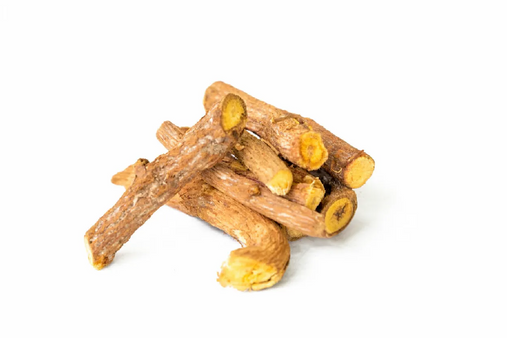
It is a twining vine with heart-shaped leaves, and it often climbs trees and walls. The stem is the part mostly used. Leaves and root are used less often. Fresh, thick, green stems are preferred over old dry pieces.
Giloy in the classical texts
Guduchi is described in the nighantus, the classical texts that list herbs and their properties. The verse below is from the Bhavaprakasha Nighantu and sums up how Ayurveda sees it.
गुडूची कटुका तिक्ता स्वादुपाका रसायनी ।
संग्राहिणी कषायोष्णा लघ्वी बल्याऽग्निदीपनी ॥
दोषत्रयामतृड्दाहमेहकासांश्च पाण्डुताम् ।
कामलाकुष्ठवातास्रज्वरकृमिवमीन् हरेत् ॥
Meaning: Guduchi is pungent and bitter in taste, sweet after digestion, and a rasayana. It is mildly astringent, warming and light, gives strength and kindles digestion. It is said to calm the three doshas, ama (undigested residue), thirst, burning, urinary problems, cough, pallor, jaundice, skin disease, fever, worms and vomiting.
Source: Bhavaprakasha Nighantu, Guduchyadi Varga, verses 8 to 10 (the last line of verse 10 is not shown).
Properties at a glance (as per the verse above)
- Taste (rasa): bitter and pungent, with a little astringency.
- Quality (guna): light.
- Potency (virya): warming.
- After-digestion effect (vipaka): sweet. This is why it is used where there is burning, even though it tastes bitter.
- Doshas: described as balancing all three. Different texts stress different doshas, so a vaidya decides based on the person.
If these terms are new, read the three doshas first.
What other classical texts say about Giloy
The verse above is only one source. A 2022 review of Guduchi in the Journal of Ayurveda and Integrated Medical Sciences collects the classical references, and they show how widely the herb is used:
- Charaka Samhita: Guduchi is placed in seven of the groups of ten herbs (dashemani). It is described as holding the stool (sangrahika) and as relieving constipation (vibandha) in other contexts, and it is used for jaundice, fever and vatarakta (a painful joint and blood condition).
- Sushruta Samhita: The review says Guduchi is mentioned in many places across several herb groups, is listed among bitter vegetables, and is used for skin disease, long-standing fever, breathlessness and loss of taste.
- Ashtanga Hridaya: It appears in several groups, including the Guduchyadi group.
- Nighantus: The Dhanvantari Nighantu describes two kinds of Guduchi, and later nighantus including the Bhavaprakasha place it among the rasayana and digestion-kindling herbs.
I am quoting this from the review. Verse numbers differ between editions, so please check the text you own if you plan to quote one.
Why the texts do not fully agree
If you read more than one source, you will notice that Guduchi's potency is usually called warming, but the Ashtanga Hridaya is listed as calling it cooling. Its taste is mainly bitter, with astringency in several texts, and its after-digestion effect is mostly sweet, though some texts say pungent. This is normal in Ayurveda. Texts were written in different centuries, and the two kinds of Guduchi mentioned in the Dhanvantari Nighantu may not always have been told apart. It is another reason a vaidya, and not a single line from a book, should decide how to use it.
Traditional benefits of Giloy
- Fever: classical texts list it among herbs for long-lasting fevers (jirna jwara). It was used in the recovery stage, when weakness stays after the fever goes.
- Digestion: described as deepana (kindles digestion) and light to digest. It is also said to clear ama.
- Burning and pitta: its sweet post-digestive effect is used for burning sensations in the body, hands and feet, and for excess thirst.
- Skin and blood: mentioned for skin conditions and joint complaints, usually along with other herbs.
- Urinary and liver complaints: the verse lists urinary problems and jaundice. These are conditions for a vaidya or doctor to treat, not for self-treatment.
- General strength: a rasayana, taken regularly under guidance.
Related reading: Agni (digestive fire) explained.
Forms of Giloy and how each is used
- Churna (powder): dried stem ground fine. Easy to measure and store.
- Fresh stem juice (swarasa): the stem is crushed and pressed. Strong and very bitter.
- Decoction (kwatha): pieces of stem boiled in water and reduced. The most common home method.
- Satva: a starch-like extract made from the stem and settled out of water. Milder in taste.
- Ghan vati (tablets): concentrated extract pressed into tablets. Convenient, but quality depends on the maker.
- In formulations: Guduchi appears in many classical preparations. The 2022 review lists Guduchyadi Churna, Guduchi Taila (oil), Guduchi Ghrita, Amritarishta, Amrita Guggulu, Dashmoolarishta and Chyavanprash. In these it works together with other herbs and a fixed method, and a vaidya prescribes them. They are not taken like a daily supplement.
How to take Giloy and usual dosage
- Churna (powder): commonly 1 to 3 g, once or twice a day, with warm water or honey.
- Fresh stem juice: about 10 to 20 ml, as advised by a vaidya.
- Decoction: a small piece of stem, about the length of a finger, boiled in water until it reduces by about half. Strain and drink warm.
Doses vary with age, strength and the condition, so ask a qualified vaidya. Take it in the morning on an empty stomach, or as advised. Start with a short course.
Quick table: Giloy by what you notice and when to take it
Ayurveda describes Giloy's uses by dosha and by complaint. This is the traditional way of grouping them, so use it as a guide and not as a diagnosis.
| Dosha Cause (what you notice) | Key Classical Herb | Best Application Time |
|---|---|---|
| Pitta: burning sensations in the body, hands and feet, and excess thirst | Giloy (Guduchi), whose sweet post-digestive effect is used for burning | Morning on an empty stomach, or as a vaidya advises |
| Weak Agni and ama: slow, heavy digestion | Giloy (Guduchi), described as deepana (kindles digestion) and light to digest | Morning on an empty stomach, or as a vaidya advises |
| Lingering weakness after a long-lasting fever has gone | Giloy (Guduchi), listed among herbs for long-lasting fevers (jirna jwara) | Morning on an empty stomach, as a short course, as a vaidya advises |
These pairings come from traditional use, not from human trials. A fever that does not settle, or any persistent problem, needs a vaidya or doctor.
How to choose good Giloy
- Fresh stems should be green, thick and juicy, not thin or woody.
- Powder should smell bitter and earthy, with an even colour and no mustiness.
- Buy from a seller who names the plant (Tinospora cordifolia) and the part used.
- Avoid products that mix in other powders without listing them. Check the label for licence and batch details.
- Giloy is often confused with other Tinospora plants. The 2022 review mentions adulteration with Tinospora sinensis, T. crispa and T. malabarica. This is why you should buy from a seller who states the botanical name Tinospora cordifolia.
- For powders, quality standards exist. The review lists limits on foreign matter (not more than 2 percent), total ash (not more than 7 percent) and lead (not more than 10 ppm). A reputable maker can tell you whether a batch was tested.
What modern research says about Giloy
This is the part where I want to be careful, because giloy became very popular in recent years and the claims often run ahead of the evidence.
- The same 2022 review says most of the therapeutic claims rest on the classical texts, animal studies and uncontrolled studies. It reports no solid numbers from controlled human trials. It mentions small human work, for example as an add-on in diabetic foot ulcers and in children with learning difficulties, without figures, and lab studies in diabetic rats showing lower blood sugar.
- The review itself notes that there is no evidence that giloy treats COVID-19, and that its safety is weakly documented.
- Doctors in India have published a case series on liver injury linked to Tinospora cordifolia, titled Herb-induced Liver Injury: A Guide to Approach. Lessons from the Tinospora cordifolia (Giloy) Case Series Story. I could not open the full paper to quote numbers, so I am only pointing you to it. The takeaway is plain: natural does not mean harmless, and long, unsupervised use is not wise.
So a fair summary is that giloy has a long record in the classical texts and is interesting enough to study, but I could not find strong human trials showing it prevents illness or boosts immunity. Be careful with any product that promises that.
Side effects and who should avoid it
- Can cause constipation or stomach upset in some people.
- It may lower blood sugar, so people on diabetes medicines should check first.
- People with autoimmune conditions, those having surgery soon, and pregnant or breastfeeding women should ask a doctor first.
- Doctors in India have reported cases of liver injury with heavy or unsupervised use. Do not take large amounts or take it for months without advice. Stop it and see a doctor if you notice yellow eyes, dark urine or unusual tiredness.
- Giloy can interact with medicines that suppress the immune system.
Common mistakes
- Taking it daily for a long time "for immunity" without advice.
- Using juice and powder together, which doubles the dose.
- Choosing very high doses because the herb is mild by reputation.
- Using it in place of treatment for fever that does not settle. Persistent fever needs a doctor.
FAQs
Can I take Giloy every day?
Short courses are common. For daily long-term use, take advice from a vaidya.
Is Giloy good for immunity?
Ayurveda calls it a rasayana. It is not a replacement for medical treatment.
Is Giloy the same as Guduchi and Amrita?
Yes. Guduchi and Amrita are the Sanskrit names for Giloy (Tinospora cordifolia).
Can Giloy harm the liver?
Doctors in India have published cases of liver injury linked to giloy, mostly with heavy or long, unsupervised use. If you have liver disease, take any liver medicine, or notice yellow eyes, dark urine or unusual tiredness, stop it and see a doctor.
Does Giloy cure fever or boost immunity?
The classical texts list it for long-standing fever and as a rasayana. I could not find strong human trials that show it prevents illness or boosts immunity, and a fever that does not settle needs a doctor.
Giloy juice or powder, which is better?
Both are used. Fresh juice is stronger and bitter, powder is easier to measure.
When should I take it?
Usually in the morning on an empty stomach, or as your vaidya advises.
Can children take Giloy?
Only on the advice of a vaidya or paediatrician, in a much smaller dose.
Is Giloy safe with diabetes medicines?
It can lower blood sugar further. Check with your doctor and monitor your sugar.
गिलोय रोज़ ले सकते हैं?
थोड़े समय के लिए आम है। लंबे समय के लिए वैद्य से पूछें।
गिलोय कब लें?
आमतौर पर सुबह खाली पेट, या वैद्य की सलाह अनुसार।
गिलोय के नुकसान क्या हैं?
कब्ज, पेट की गड़बड़ी और शुगर कम होना। ज़्यादा मात्रा न लें।
गर्भावस्था में गिलोय लें?
नहीं, पहले डॉक्टर से पूछें।
गिलोय का काढ़ा कैसे बनाएं?
उंगली जितना ताज़ा तना कूटकर पानी में उबालें, आधा रह जाए तो छानकर गुनगुना पिएं।
Sources: Bhavaprakasha Nighantu, Guduchyadi Varga; Ninama R et al., "An exploration of physiological, medicinal and safety aspects of Guduchi (Tinospora cordifolia): A complete Ayurvedic and modern review," Journal of Ayurveda and Integrated Medical Sciences, 2022;7(4); "Herb-induced Liver Injury: A Guide to Approach. Lessons from the Tinospora cordifolia (Giloy) Case Series Story," Journal of Clinical and Experimental Hepatology, 2021. This is traditional information, not medical advice. Consult a qualified vaidya or doctor before use.
By Nipa Katkoria, Founder, Trutatva · Based on classical texts and personal experience