In short
Ghee (ghrita) is one of the most loved foods in Ayurveda, said to help digestion, calm Vata and Pitta, and support the eyes and memory. Keep it to 1 to 2 teaspoons a day in warm food, and check with a vaidya if you have high cholesterol or heart disease.
In Ayurveda, ghee (ghrita) is one of the most loved foods. It is said to help digestion, calm Vata and Pitta, and support the eyes and memory. It works best in small amounts, mixed into warm food. People with high cholesterol, heart disease, or a weak, sluggish digestion should go slower and check with their doctor first.
4 min read
What the classical text says
Vagbhata, in the Ashtanga Hridaya (Sutrasthana, chapter 5, verses 37 to 39), describes ghee in praise. In one translation it is called good for wit, memory, intellect, digestion, strength, long life, vitality, the eyes, and for children and the elderly. It is also said to calm wind (Vata), bile (Pitta) and poison, and to help keep a person young.
Ghee is recommended for wit, memory, intellect, digestion, strength, long life, the eyes, and for children and old people; it calms wind and bile.
Source: Ashtanga Hridaya, Sutrasthana 5.37 to 39 (English translation; the Sanskrit text is not shown here).
These are traditional claims. Please read them as what Ayurveda teaches, not as promises that ghee will treat any illness.
How Ayurveda uses ghee
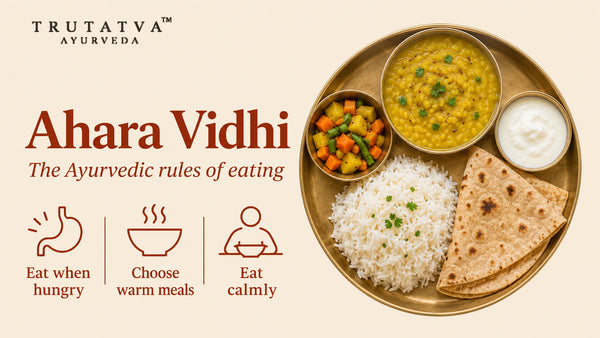
- For digestion. A little ghee on warm rice or dal is said to support Agni, the digestive fire. See our guide on Agni.
- For Vata and Pitta. Its soft, oily and cooling nature is said to calm dry Vata and hot Pitta. Our post on Vata dosha imbalance has more on this.
- As a carrier. Many Ayurvedic preparations are made in ghee, because it carries the herbs' qualities well.
How to eat ghee at home
- Stir about a teaspoon into hot dal, khichdi or rice.
- Spread a little on a warm roti or phulka.
- Use it for tempering (tadka) and light cooking.
- Take it with food, not on a completely empty stomach, unless your Ayurvedic doctor has told you to.
How much is okay?
One tablespoon of ghee (about 14 g) has roughly 120 calories and nearly 9 g of saturated fat. For a 2,000 calorie diet, the Indian dietary guidelines (ICMR-NIN 2024) say to keep ghee and butter to about 1 to 2 teaspoons a day and to get the rest of your fat from other oils. So keep it small: a teaspoon or two a day in food is plenty for most people.
Who should go slow with ghee
- People with high LDL cholesterol or heart disease: please ask your doctor first.
- Anyone on a low fat diet or trying to lose weight.
- People with a weak appetite, a heavy feeling or a thick coating on the tongue. Ayurveda calls this Ama, and says to correct it before adding more oily food. See our post on Ama.
- People with a milk allergy: ghee has very little milk protein, but a trace can remain.
- During fever or a heavy cold, keep it light until you feel better.
Frequently asked questions
Is ghee good for you every day?
A small amount, about 1 to 2 teaspoons in food, is fine for most healthy people. If you have a heart or cholesterol problem, ask your doctor.
Can I eat ghee for weight loss?
Ghee is rich in calories, so keep it small if you are losing weight. It does not melt fat by itself.
Is ghee better than butter?
Ghee has very little lactose, so some people who struggle with butter find it easier. It still has plenty of saturated fat, so the amount matters.
Can children eat ghee?
Ayurveda recommends it for children in small amounts in their food. Ask your child's doctor if they have any health problem or allergy.
घी खाने के फ़ायदे क्या हैं?
आयुर्वेद में घी को पाचन, याददाश्त, आंखों और ताकत के लिए अच्छा माना गया है और यह वात और पित्त को शांत करता है।
रोज़ कितना घी खाना चाहिए?
आमतौर पर खाने में डेढ़ से दो चम्मच काफ़ी है। हार्ट की बीमारी या कोलेस्ट्रॉल हो तो डॉक्टर से पूछें।
किन्हें घी नहीं खाना चाहिए?
जिनका कोलेस्ट्रॉल या वज़न बहुत है, हार्ट की समस्या है, या पाचन बहुत कमज़ोर है, वे संभलकर और डॉक्टर से पूछकर लें।
Source: Ashtanga Hridaya, Sutrasthana 5.37 to 39. Nutrition figures per tablespoon and the daily limit from ICMR-NIN Dietary Guidelines for Indians (2024), as cited by 1mg.
Disclaimer: This article is for general information about traditional Ayurvedic practice and is not medical advice. If you have a health condition, please speak to a doctor before changing your diet.